What is llms.txt, and does your website need one?
By José Antonio Mijares | 2026-11-27 | 6 min read
llms.txt is a short Markdown file at the root of your website that tells AI tools what you do and which pages to read first. What goes in it, who actually reads it today, and whether it's worth the twenty minutes.
llms.txt is a short Markdown file at the root of your website (yoursite.com/llms.txt) that tells AI tools what your business is and which pages to read first. It was proposed in 2024 and it isn't an official standard: Google Search doesn't use it, and most AI crawlers rarely ask for it. It's still cheap to write, and coding assistants that read documentation do use it.
What it is
Jeremy Howard of Answer.AI proposed the format in September 2024 at llmstxt.org. The idea: a web page full of menus, scripts and banners is a messy thing for a language model to read. A plain Markdown note that says "here's who we are, here's what to read" is not.
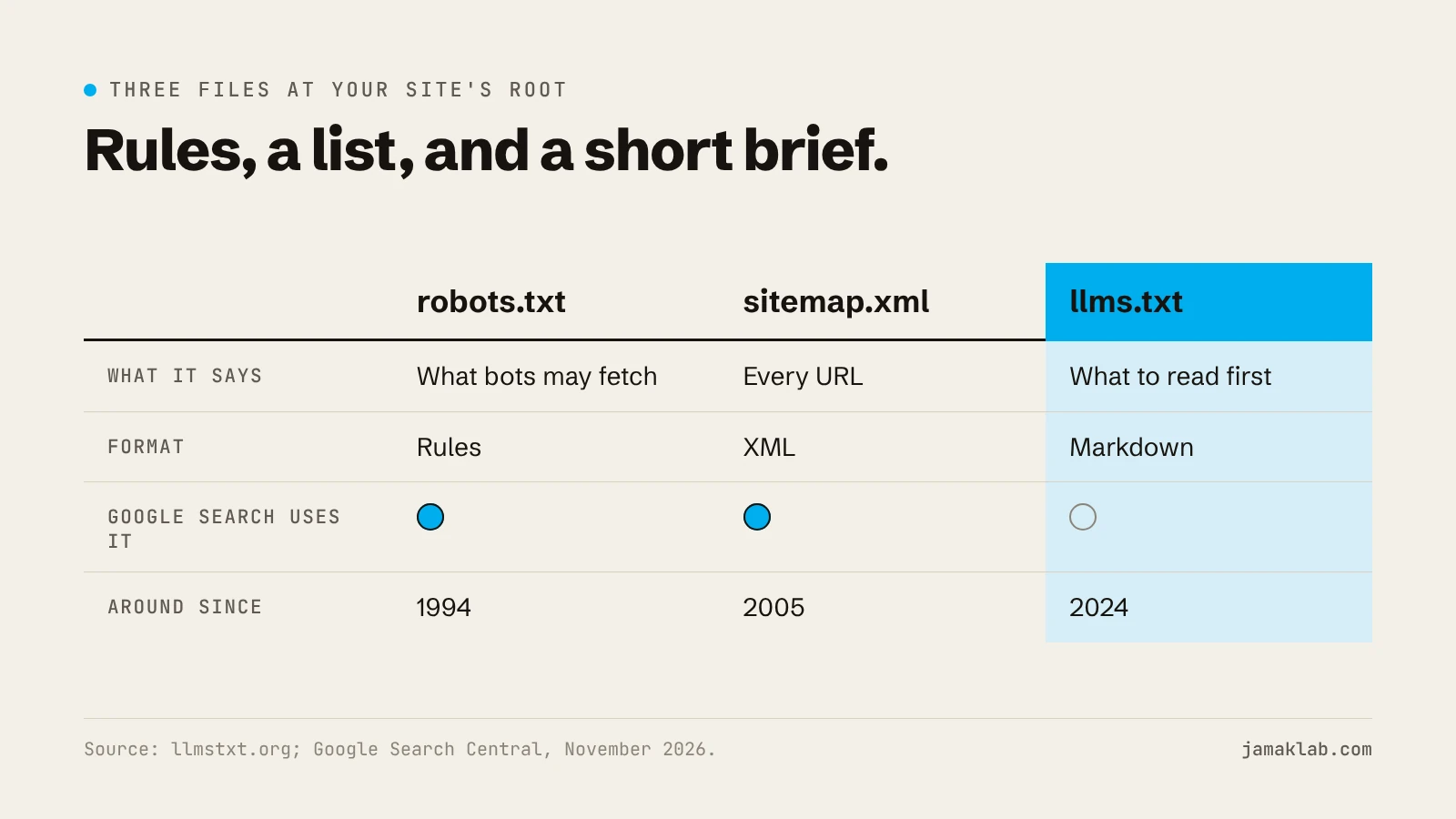
It sits next to two files your site probably already has:
| robots.txt | sitemap.xml | llms.txt | |
|---|---|---|---|
| What it says | Which pages bots may fetch | Every URL you want found | What to read first, in plain words |
| Format | Rules | XML | Markdown |
| Who reads it | Every major crawler | Search engines | Some AI tools, mostly coding assistants |
| Does Google Search use it? | Yes | Yes | No |
| Around since | 1994 | 2005 | 2024 |
What goes in the file
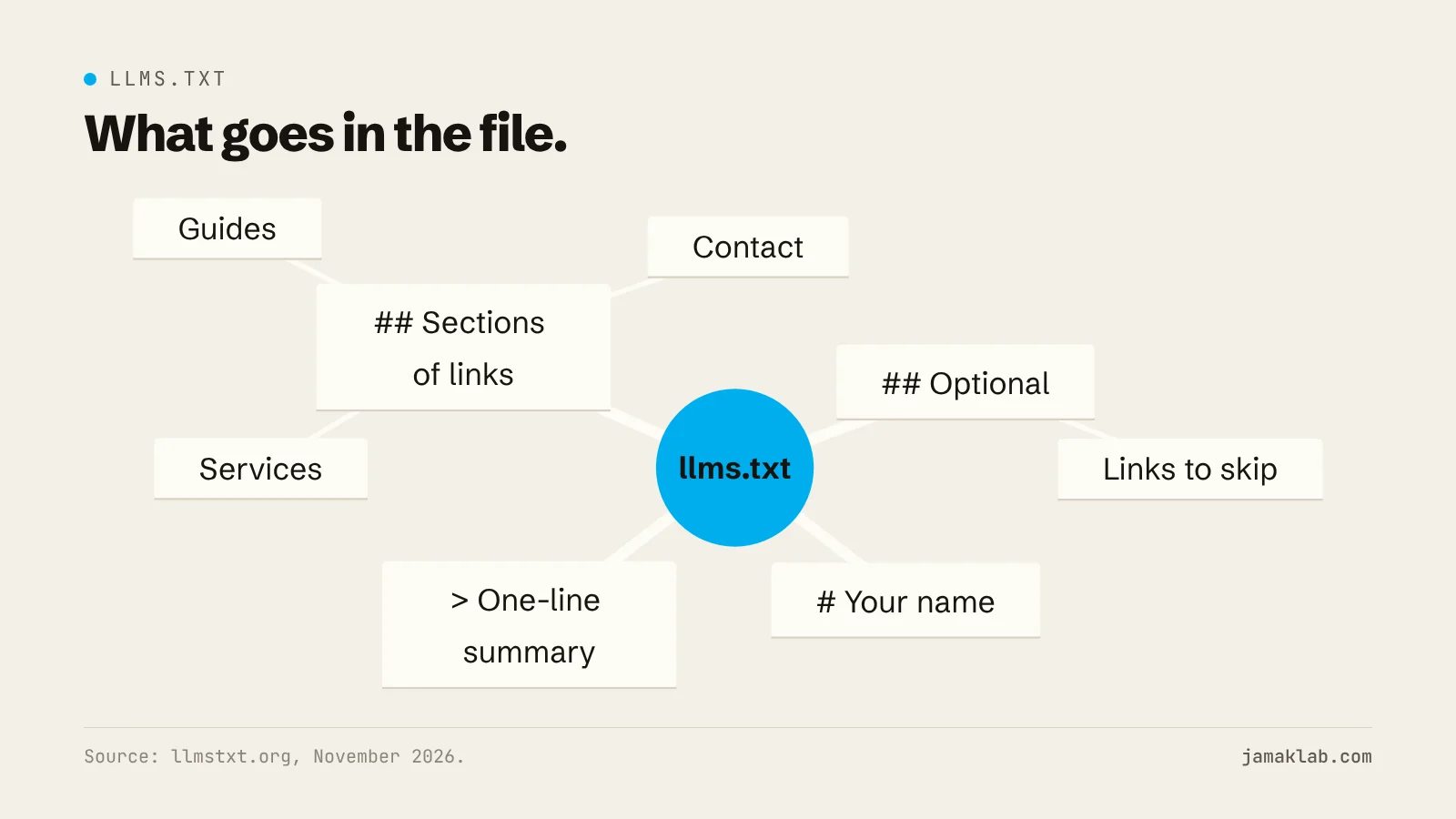
The format is deliberately small:
- An H1 with your name. The only required line.
- A one-line summary in a blockquote: what you do and for whom.
- A few short notes, if you need them: where you work, what you don't do.
- Sections of links under H2 headings, each link with a few words on what's there.
- An "Optional" section for links a reader with little room can skip.
A small agency's file might look like this:
# Northline Studio

> Web design and SEO for dental clinics in Texas.

We build sites and run local SEO. We don't do paid ads.

## Services
- [Dental websites](https://northline.example/websites): design, build, hosting
- [Local SEO](https://northline.example/seo): Google Business Profile, reviews, rankings

## Optional
- [Blog](https://northline.example/blog): monthly articles

Who actually reads it
Honestly, not many crawlers yet:
- Google Search doesn't use it. Google's own guidance for its AI features says you don't need special AI files or markup to appear in AI Overviews or AI Mode (Google Search Central).
- AI crawlers rarely fetch it. Ahrefs analyzed 137,000 sites and found that 97% of the llms.txt files among them got zero requests in May 2026 (Ahrefs).
- Coding assistants do use it. Developer docs are where it took off: tools that write code fetch a library's
llms.txtto read its docs without the page clutter.
Should you add one?
Yes, if it takes you less than an hour, and with the right expectations. It won't move a ranking and it won't, by itself, get you named by ChatGPT. What it does:
- Gives any tool or person who looks a clean, correct summary of your business.
- Forces you to write that summary, which is the same work GEO asks for anyway: plain facts, the same everywhere.
- Costs nothing to keep, as long as you update it when your services or prices change.
If you have developer docs or an API, it matters more: that's the audience that reads it. Either way, check robots.txt first. A blocked AI crawler can't read anything, llms.txt included. We wrote more about the file's history and common mistakes in why every website needs an llms.txt file.
Frequently Asked Questions
Q: What is llms.txt?
A Markdown file at the root of a website (/llms.txt) that gives AI tools a short summary of the site and links to its most useful pages. Jeremy Howard of Answer.AI proposed it in September 2024. It's a convention, not an official standard.
Q: Is it llms.txt or llm.txt?
llms.txt, plural. That's the name in the proposal at llmstxt.org. Some sites also publish llm.txt as a copy, which doesn't hurt.
Q: Does Google use llms.txt?
No. Google says you don't need special AI files or markup to appear in AI Overviews or AI Mode. Ranking and appearing in Google's AI answers depend on the same things as regular search.
Q: Does llms.txt help you show up in ChatGPT?
Not directly. AI crawlers rarely request the file: an Ahrefs study found 97% of llms.txt files got zero requests in May 2026. Being cited by ChatGPT depends on crawlable pages, clear facts and mentions on other sites.
Q: How is llms.txt different from robots.txt?
robots.txt sets rules: which pages crawlers may fetch. llms.txt gives a summary: what your site is and what to read first. One controls access, the other offers a reading list.
Key Takeaways
- llms.txt is a short brief: your name, a one-line summary and links to your best pages, in Markdown
- It's a proposal, not a standard: Google Search doesn't use it, and most AI crawlers rarely fetch it
- Coding assistants do read it: it matters most for sites with docs or an API
- Cheap to ship: write it in under an hour, update it when your offer changes
- Check robots.txt first: a blocked AI crawler can't read any of your files
Want your site checked for what AI crawlers can and can't read? See our GEO service or talk to us.