SEO vs AEO vs GEO: what's the difference, and which one do you need?
By José Antonio Mijares | 2026-11-26 | 7 min read
SEO gets your pages ranked. AEO gets your page picked as the direct answer. GEO gets your brand named and cited inside AI answers from ChatGPT, Gemini, Perplexity and Google's AI Overviews. What each one is, how they overlap, and which to start with.
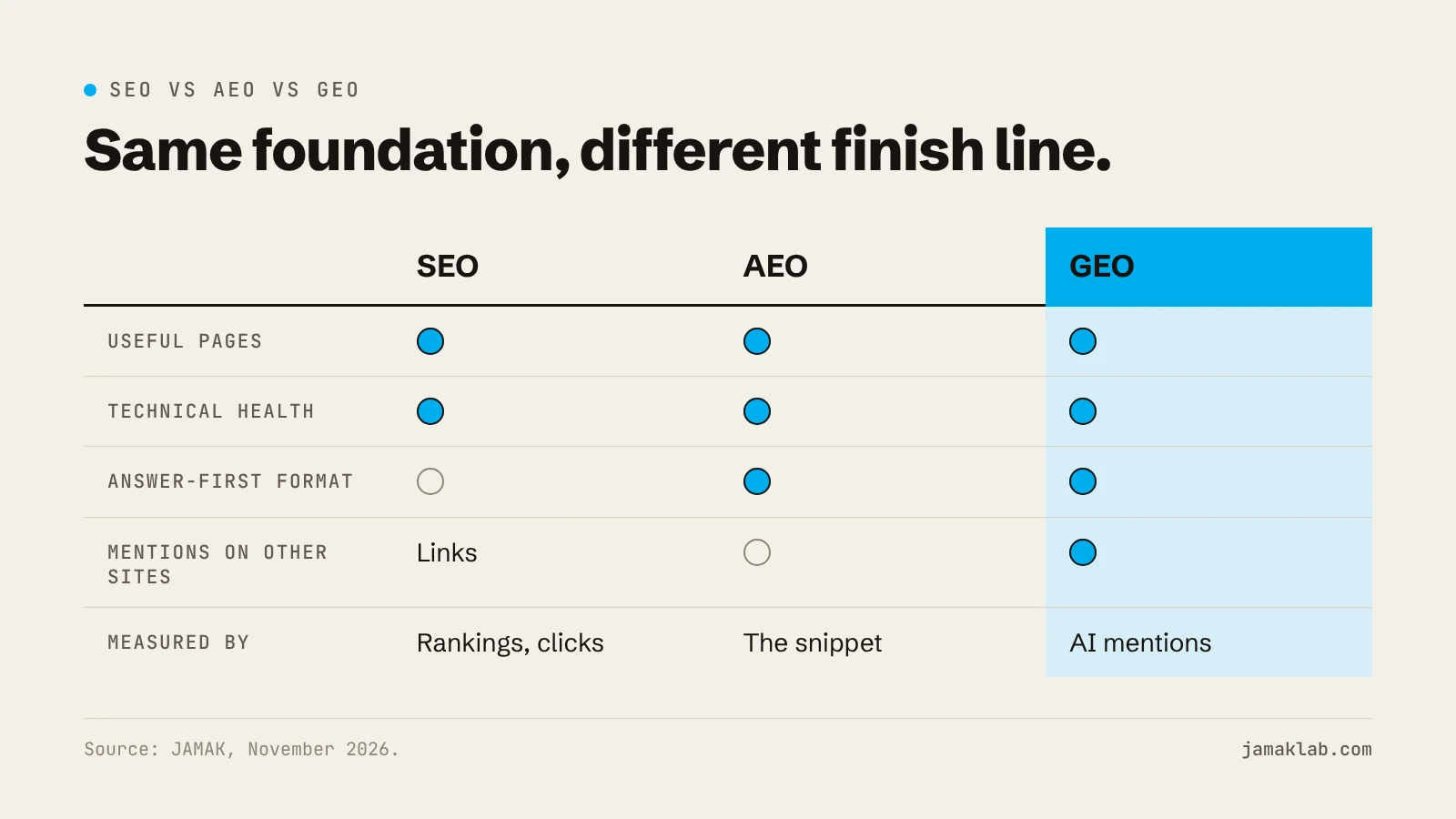
SEO gets your page ranked. AEO gets your page picked as the direct answer. GEO gets your brand named and cited inside the answers AI assistants write. They aren't three separate jobs: GEO and AEO sit on top of SEO, and most of the work overlaps.
A quick way to tell them apart is to ask what "winning" looks like:
| SEO | AEO | GEO | |
|---|---|---|---|
| Stands for | Search engine optimization | Answer engine optimization | Generative engine optimization |
| Where you show up | Google and Bing results, the blue links | Featured snippets, People Also Ask, voice answers, AI answer boxes | Answers from ChatGPT, Gemini, Perplexity, Claude, Google AI Overviews and AI Mode |
| What winning looks like | A ranking and a click | Your page is the answer | Your brand is named or your page is cited |
| What it's measured with | Rankings, clicks, Search Console | Snippet and PAA ownership | Mentions and citations across AI assistants |
| Main levers | Useful pages, technical health, links | Short direct answers, clear structure, schema | Facts stated plainly, mentions on other sites, crawlable pages |
| Since | The late 1990s | The featured-snippet and voice-assistant years | Named in a 2023 research paper |
SEO: get ranked
SEO is the work of making your pages show up in search results and earn the click. It's three things done well: pages that answer what people search, a site search engines can crawl and load fast, and links from other sites that vouch for it.
It's still the foundation for the other two. Google says there's no special trick for its AI features: the same SEO best practices apply to AI Overviews and AI Mode (Google Search Central). And ChatGPT and Perplexity search the web too, often leaning on pages that already rank.
AEO: be the answer
AEO is the narrower job of being the one answer a search engine or assistant shows, not one of ten links. The term predates ChatGPT: it grew out of featured snippets and voice assistants, where there's room for exactly one answer.
What helps:
- Answer first. Put a one or two sentence answer right under the question, then explain.
- Use the question as the heading. "How much does X cost?" as an H2, answered in the paragraph below it.
- Structure what's a list or a table. Steps as numbered lists, comparisons as tables, FAQs marked up with schema.
You're reading an example: this guide answers in its first paragraph.
GEO: get cited by AI
GEO is about the answers generative AI writes. The name comes from a 2023 paper by researchers at Princeton and IIT Delhi, GEO: Generative Engine Optimization, presented at KDD 2024. On their own benchmark, methods like adding statistics, quotations and cited sources raised a page's visibility in AI answers by up to 40% (arXiv 2311.09735). That's one study's lab result, not a promise, but the direction matches what we see.
An AI answer is built from what the model learned and what it finds when it searches, so GEO works on both:
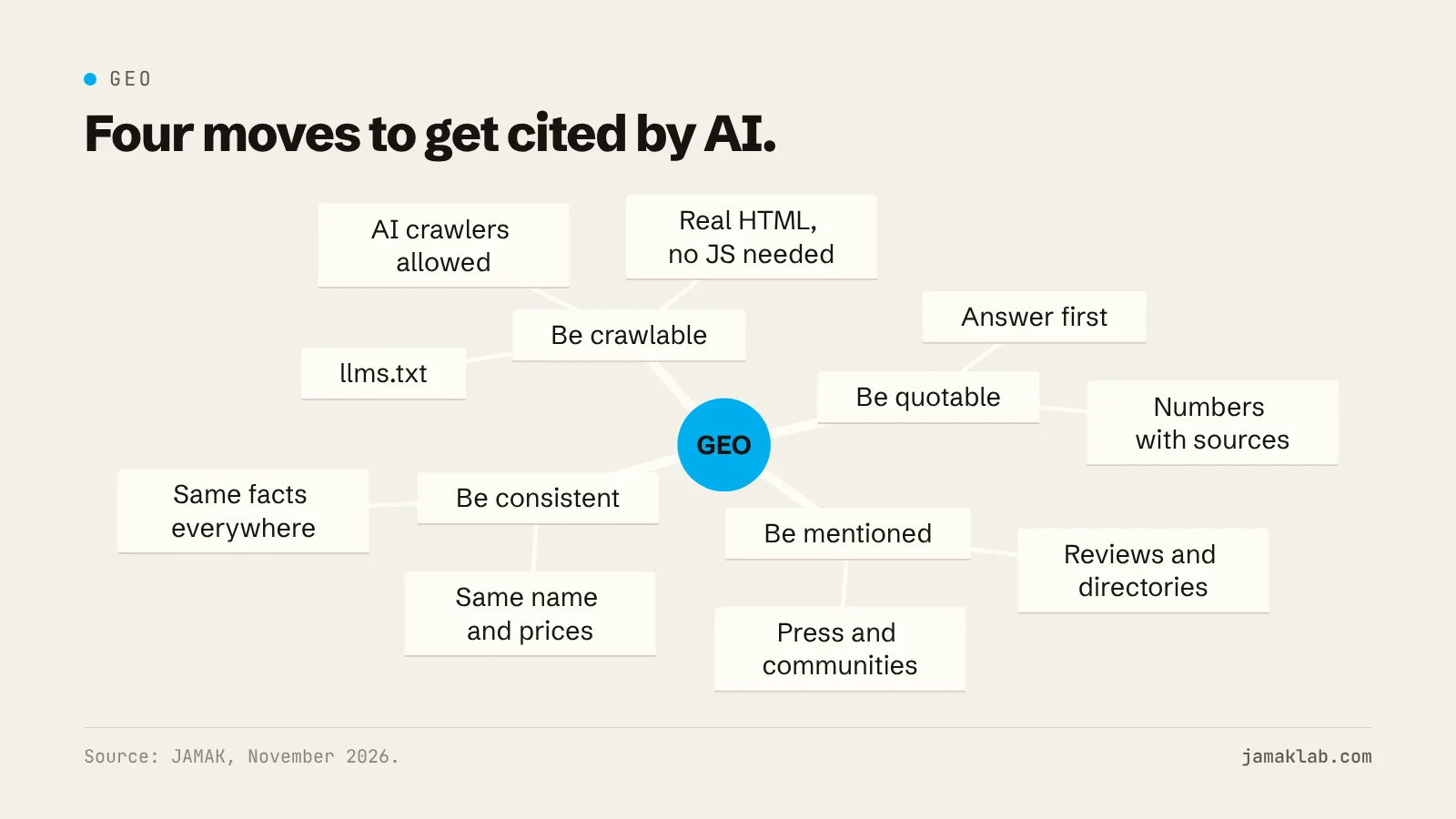
- Be crawlable. If AI crawlers are blocked in
robots.txt, or your page is an empty JavaScript shell until a browser runs it, the assistant can't read you. An llms.txt file gives them a clean summary. - Be quotable. Short, plain statements of fact, with numbers and their source. Models lift sentences; give them good ones.
- Be mentioned elsewhere. Assistants trust what several independent sources repeat: reviews, directories, articles, forums. This is the part SEO teams used to call "brand" and skip.
- Be consistent. The same company name, prices, hours and claims on your site, your profiles and your listings. Contradictions make a model hedge or leave you out.

For the full playbook, read our GEO guide.
Where they overlap, and where they don't
Most of the work helps all three: useful pages, clear answers, a fast crawlable site, schema, a good reputation. The differences are at the edges:
- SEO alone cares about rankings for a keyword and the click. A page can rank #3 and never be the snippet or the AI citation.
- AEO cares about the format of one answer on your page.
- GEO cares about what's said about you off your site, and it's measured differently: you check whether ChatGPT, Gemini and Perplexity name you when someone asks, not where you rank. See how to check if ChatGPT cites your brand.
Which one should you start with?
- If your site isn't ranking for anything yet: start with SEO. Without it, AEO and GEO have nothing to work with.
- If you rank but don't get the snippet or the AI Overview: rewrite your best pages answer-first. That's AEO, and it's cheap.
- If customers say "I asked ChatGPT and it recommended your competitor": that's GEO. Check what the assistants say about you today, then fix what's missing on your site and off it.
Whichever you start with, measure it. Rankings come from Search Console; AI mentions don't, so you have to ask the assistants on a schedule. That's what our own platform, Ezeo, does for the sites we work on.
Frequently Asked Questions
Q: What is the difference between SEO, AEO and GEO?
SEO gets a page ranked in search results. AEO gets a page chosen as the direct answer, like a featured snippet or a voice answer. GEO gets a brand mentioned or a page cited inside answers written by AI assistants such as ChatGPT, Gemini, Perplexity and Google's AI Overviews.
Q: Is GEO replacing SEO?
No. GEO builds on SEO. AI assistants that search the web lean on pages that already rank, and Google says the same SEO best practices apply to its AI features. GEO adds work SEO often skipped: mentions on other sites and consistent facts everywhere.
Q: Is AEO the same as GEO?
They overlap but aren't the same. AEO is about being the single answer a search engine shows. GEO is about being named and cited in answers an AI model writes, which also depends on what other sites say about you.
Q: Where does the term GEO come from?
From a 2023 research paper, GEO: Generative Engine Optimization, by researchers from Princeton and IIT Delhi, presented at KDD 2024. On their benchmark, adding statistics, quotations and sources raised visibility in AI answers by up to 40%.
Q: How do I measure GEO?
Ask the AI assistants the questions your customers ask, on a schedule, and record whether they mention or cite you. Search Console doesn't report it. Tools like Ezeo automate the asking and track the results over time.
Key Takeaways
- SEO ranks, AEO answers, GEO gets cited: three finish lines on one foundation
- Start with SEO: without ranking pages, the other two have little to work with
- AEO is cheap: answer first, use the question as the heading, mark up FAQs
- GEO happens partly off your site: mentions, reviews and consistent facts elsewhere
- Measure each one its own way: Search Console for SEO, scheduled AI checks for GEO
Want to know where you stand on all three? See our GEO service or talk to us.