What is an API? A plain-English guide for people who don't code
By José Antonio Mijares | 2026-11-26 | 6 min read
An API is a door one program uses to ask another program for something and get an answer back. What that means in practice, what an API key is, why AI APIs charge by the token, and the questions to ask before you pay for one.
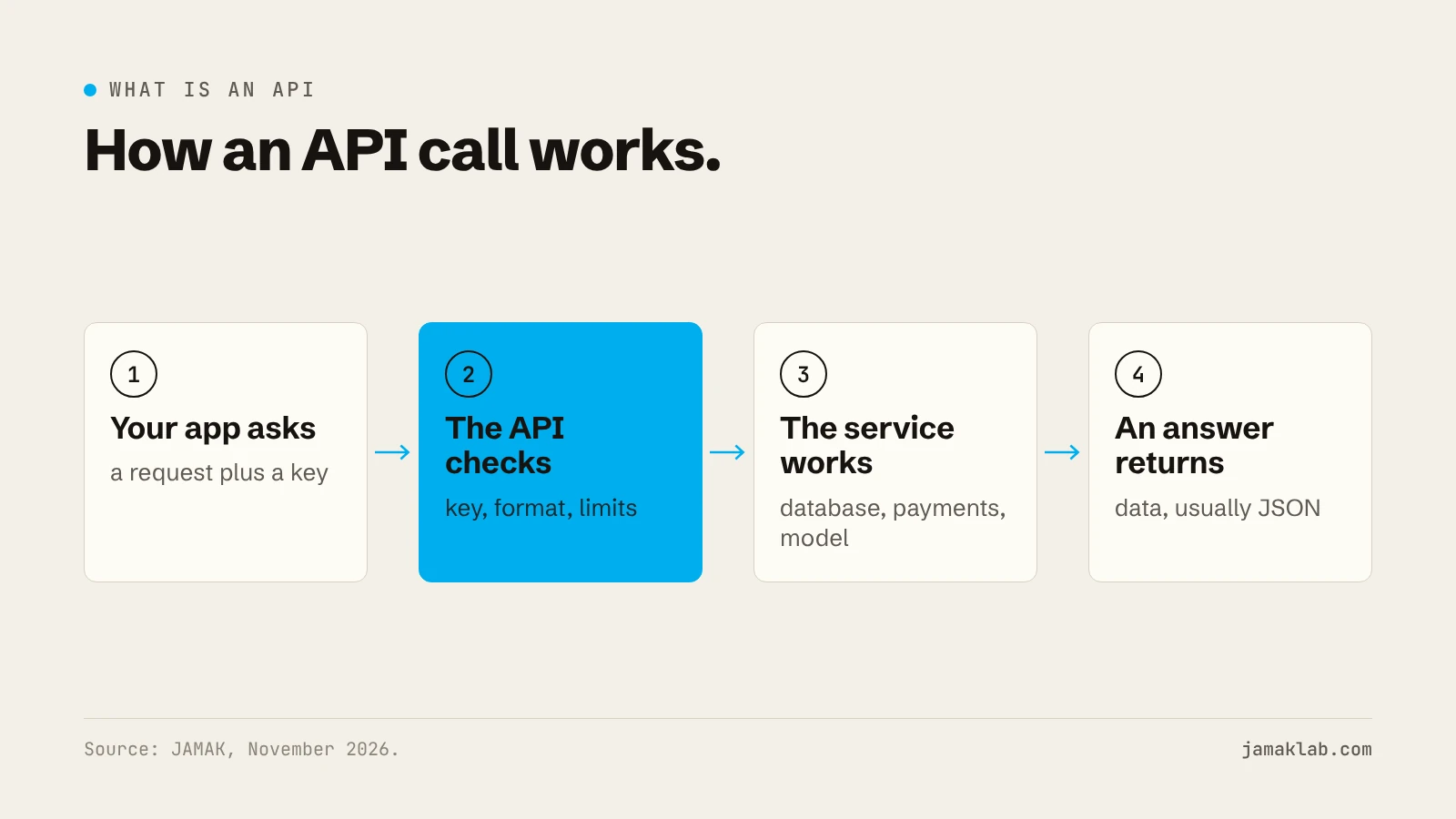
An API is a door one program uses to ask another program for something and get an answer back. When an online store shows "arrives Thursday", it asked the courier's API. When a booking site takes your card, it asked a payment company's API. When an app "uses ChatGPT" or "uses Claude", it sends your text to that company's API and shows you what comes back.
API stands for Application Programming Interface. The important word is interface: the API is the agreed list of requests you can make and the answers you'll get, so your software never needs to know how the other side works inside.
The restaurant version
The usual way to explain it is a restaurant, and it holds up:
- You are the app that wants something.
- The kitchen is the other company's system: their database, their payment network, their AI model.
- The menu is the API's documentation: what you're allowed to order, and how to ask for it.
- The waiter is the API itself: it takes a correctly written order to the kitchen and brings back the dish, or tells you the kitchen is out of it.
You never walk into the kitchen. That's the point: the kitchen can change its ovens, and as long as the menu stays the same, your order still works.
What's actually in a request
A real API request has four parts. You don't have to write one, but knowing them makes any API price page or developer conversation easier to follow:
| Part | What it is | Restaurant version |
|---|---|---|
| Endpoint | The address of one job, like /v1/messages or /invoices |
The dish on the menu |
| Method | What you want to do: read (GET), create (POST), change, delete | "I'd like to order" vs "cancel that" |
| API key | A secret that says who's asking, and who pays | Your table number on the bill |
| Body | The details, usually as JSON text | "No onions, extra sauce" |
What comes back is a response: a status code (200 means it worked, 401 means the key was wrong, 429 means you asked too often) and the data you asked for.
API vs app vs integration
People mix these up all the time, and it costs money when a quote says one and means another:
| Word | What it means | Example |
|---|---|---|
| App | Something a person uses on a screen | The ChatGPT app on your phone |
| API | Something software uses, with no screen | The OpenAI API a developer calls from their own code |
| Integration | Two systems connected through their APIs to do a job | New Shopify order → invoice created in your accounting tool |
| Webhook | An API call in reverse: the other system calls you when something happens | Stripe tells your site "this payment succeeded" |
| MCP server | An API wrapped so AI assistants can use it as a tool | What is MCP? |
A ChatGPT or Claude subscription and the same company's API are separate products with separate bills. A $20 a month chat plan doesn't include API usage, and API usage doesn't come with the chat app.
What an API key is, and how to keep it safe
An API key is a long secret string, something like sk-.... Whoever has it can make requests on your account, and you pay for them.

Three rules cover most of the risk:
- Never paste a key into a website, a chat, a screenshot or a public file. Leaked keys get found and used within hours.
- One key per project, with a spending limit. Most AI providers let you set a monthly cap in the billing settings. If one project leaks, you revoke one key.
- The key lives on a server, not in a browser. If a developer puts it in the page's own code, anyone can read it with "View source".
AI APIs: why you pay by the token
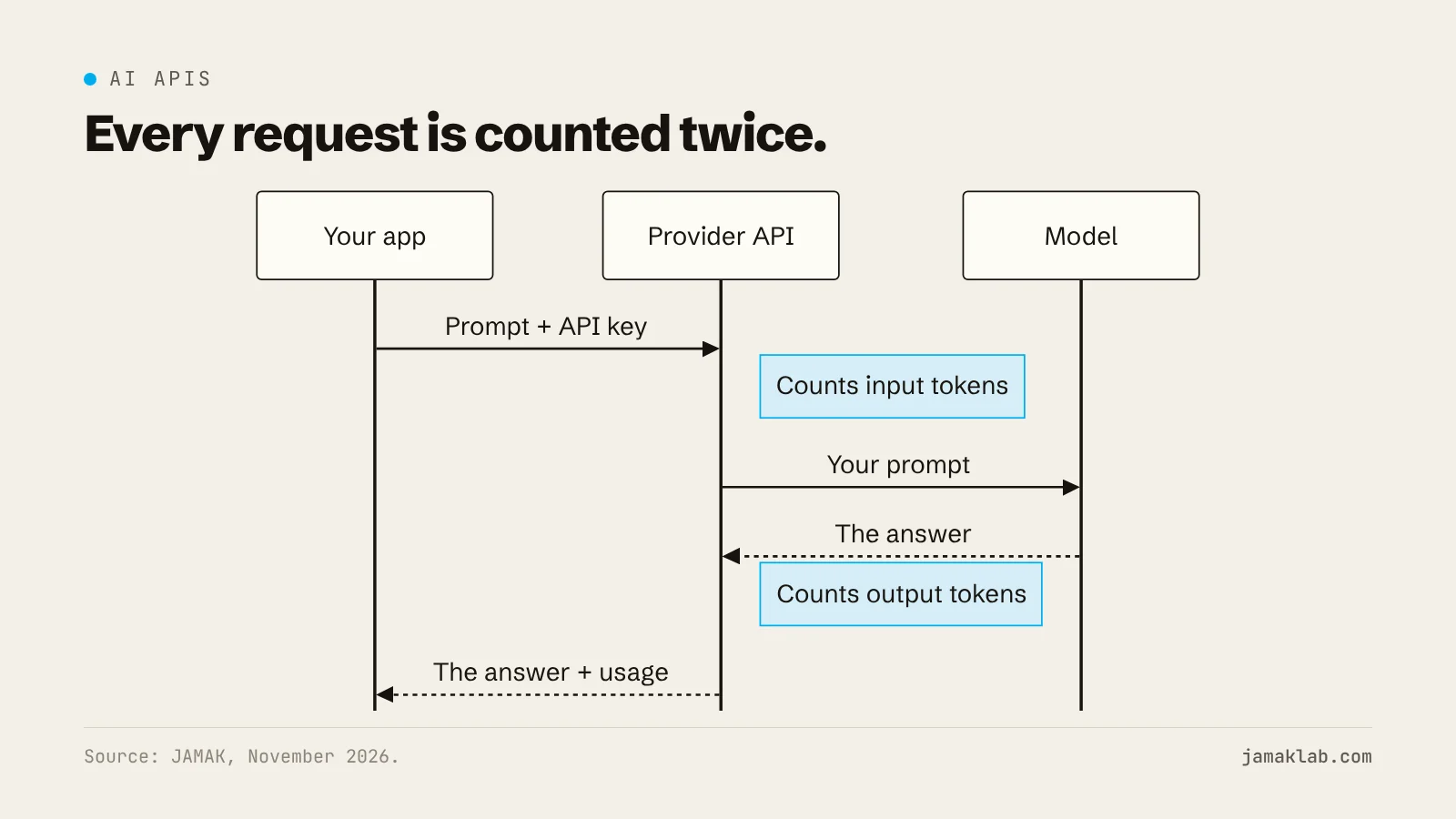
AI APIs charge per token, not per question. A token is a piece of a word: OpenAI's own rule of thumb is about 4 characters, or roughly ¾ of a word, in English. Spanish and other languages usually take a few more tokens for the same idea.
You pay for tokens in (your prompt, plus any documents you send) and tokens out (the answer), usually priced per million, and output costs more than input. So the bill depends on three things:
- Which model. The biggest models cost many times more per token than the small, fast ones. Most business jobs, like sorting emails or writing product descriptions, don't need the biggest one.
- How much you send. Pasting a 40-page PDF into every request is what makes a bill jump. Sending only the part that matters is the cheapest fix.
- How long the answers are. "Answer in three sentences" is a cost control.
Prices change often, so check the provider's own pricing page the week you budget, not a blog post. (Including this one.)
Five questions before you pay for an API
- What does one request cost, and what will a month cost at our volume? Ask for the math, not the price per million.
- What happens when it's down? Every API has outages. Your site should show a sensible message, not a blank page.
- What are the rate limits? How many requests per minute you're allowed, and what happens past that (a 429 error).
- Where does our data go? Read whether the provider trains on API data and how long it keeps it. Many AI providers don't train on API traffic by default, but check the current terms yourself.
- Who owns the key? It should be an account your business owns, not a freelancer's personal one.
Frequently Asked Questions
Q: What is an API in simple terms?
An API is a set of requests one program is allowed to send to another, and the answers it gets back. It lets two systems work together, like a store asking a courier for a delivery date, without either one knowing how the other is built.
Q: Is ChatGPT an API?
ChatGPT is an app. OpenAI also sells an API that gives developers the same kind of models to use inside their own software. They're billed separately: a ChatGPT subscription doesn't include API usage.
Q: What is an API key?
A secret string that tells the API who is calling and which account to bill. Treat it like a password: keep it on a server, never in a website's code or a chat, and set a spending limit on the account.
Q: Why do AI APIs charge per token?
Because the work a model does grows with the amount of text it reads and writes. A token is a few characters, about ¾ of an English word by OpenAI's rule of thumb, and providers charge per million tokens in and out.
Q: Do I need a developer to use an API?
To build with one, usually yes, or a no-code tool like Zapier or Make that calls the API for you. To use an AI assistant that reaches your tools, an MCP connector can be enough: see What is MCP?
Key Takeaways
- An API is a door between programs: your software asks, the other system answers, and neither sees inside the other
- A request has four parts: endpoint, method, key and body; the answer comes back with a status code
- The app and the API are different products: a chat subscription doesn't include API usage
- Guard the key: server only, one per project, with a spending cap
- AI APIs bill by the token: model size, what you send and how long the answer is set the cost
If you want an API or an AI model wired into your store or your operations without a surprise bill, see how we implement AI or talk to us.