LLM vs chatbot vs AI agent: what's the difference?
By José Antonio Mijares | 2026-11-26 | 6 min read
An LLM is the model that writes the words. A chatbot is a chat window built on one. An AI agent is a model that can use tools and take steps on its own to finish a job. What each one is, how to tell them apart, and which one a business problem actually needs.
An LLM is the model that writes the words. A chatbot is a chat window built on top of one. An AI agent is a model that can use tools and take several steps on its own to finish a job. ChatGPT, Claude and Gemini started as chatbots on top of LLMs, and now each can also act as an agent when you let it.
| LLM | Chatbot | AI agent | |
|---|---|---|---|
| What it is | The model itself | A chat interface on a model | A model with a goal, tools and permission to act |
| What you give it | Text in | A message | A job to finish |
| What you get back | Text out | A reply | A result: a booked meeting, a filed ticket, a report |
| Can it use your tools? | No | Only if someone connected them | Yes, that's the point |
| How many steps | One | One reply per message | Many, until done or stuck |
| Examples | GPT, Claude, Gemini, Llama model families | A support bubble on a website, the ChatGPT app | Claude Code, ChatGPT agent mode, a custom order-handling agent |
LLM: the engine
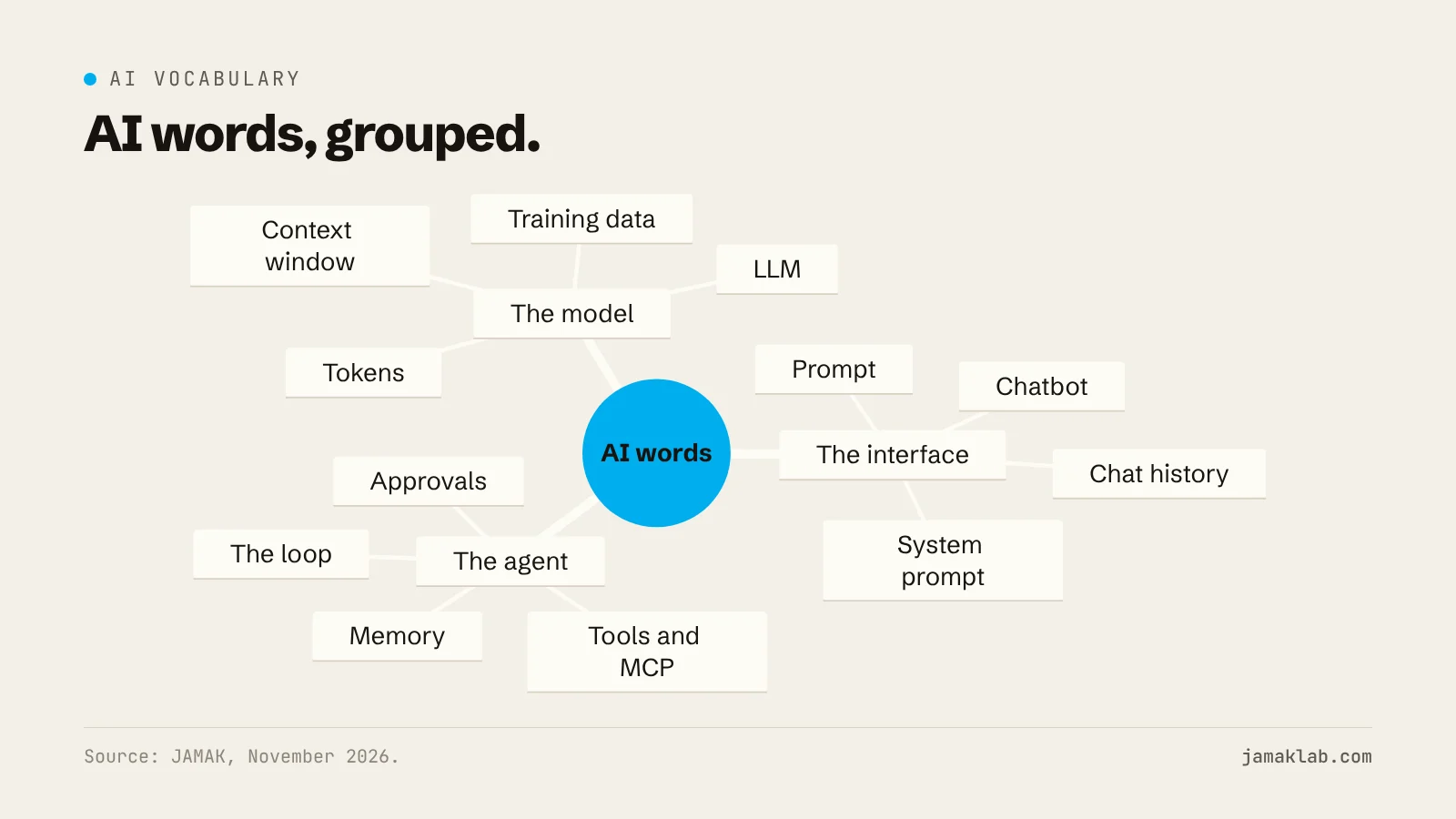
A large language model is trained on huge amounts of text to predict what comes next, and from that it learned to write, summarise, translate and reason through problems in language. On its own it has no memory between calls, no access to your files and no way to do anything except return text. (If you call one from your own software, you're using its API: see What is an API?)
Two words you'll hear with it:
- Tokens: the small pieces of text models read and write. Usage and prices are counted in them.
- Context window: how much the model can consider at once: your instructions, the conversation so far and any documents you paste in. Bigger windows read more, but cost more per request.
Chatbot: the window
A chatbot is the part you talk to. Old chatbots, the "press 1 for billing" kind on websites, followed scripts. Modern ones run on an LLM, so they understand free text and answer in full sentences.
A chatbot is the right tool when the job is one answer at a time: questions about your hours, your return policy, a product's size. Give it your real documents to answer from, and it stops guessing. It's the wrong tool when the job needs it to do something in another system.
AI agent: the worker
An AI agent is an LLM given three more things:
- A goal, not just a message: "find every order delayed more than 5 days and email those customers an update."
- Tools it can call: your store, your email, your calendar, a database. Increasingly these connect through MCP.
- A loop: it plans a step, does it, checks the result, and decides the next step, until the job is done or it needs a person.
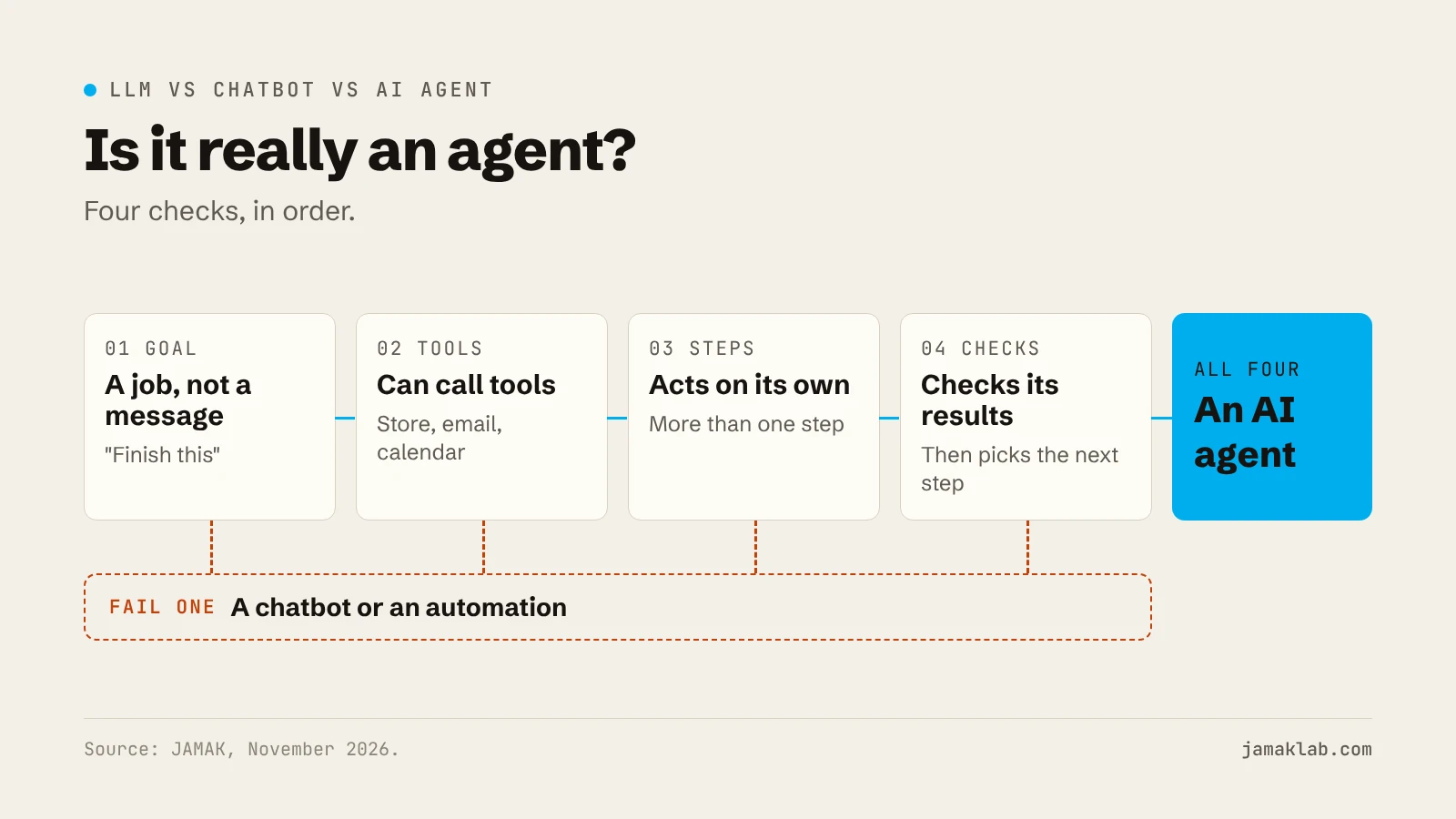
That loop is what makes agents useful and what makes them risky. An agent that can send email can send the wrong email. Good agents are built with approvals before anything that writes, sends or spends, a log of every step, and limits on what each tool can touch. We wrote about that in what a production AI agent needs.

And where does "automation" fit?
Zapier-style automation also does multi-step work across tools, but it follows fixed rules you wrote: "when a form arrives, add a row and send this email." No model decides anything. It's cheaper, more predictable, and the right choice whenever the steps never change. Use an agent when the steps depend on reading something messy, like an email, a PDF or a customer's message, and deciding what to do.
Which one does your problem need?
| If the job is… | Use | Why |
|---|---|---|
| Drafting, summarising, translating one thing at a time | An LLM in a chat app | A person stays in charge of every step |
| Answering customers' questions from your documents | A chatbot grounded in your content | One answer per question, no actions needed |
| The same fixed steps every time | An automation | Cheaper and predictable, no model needed |
| Several steps across tools that depend on reading and judging | An AI agent, with approvals | The steps change with the input |
Most businesses should start one row higher than they think. If you're weighing assistants for your own day, our comparison of six personal AI agents covers where each one is strongest.
Frequently Asked Questions
Q: What is the difference between an LLM and a chatbot?
An LLM is the AI model that reads and writes text. A chatbot is an application you talk to in a chat window. Modern chatbots, like the ChatGPT app, run on an LLM, but the chatbot adds the interface, the conversation history and any documents or tools it's connected to.
Q: What is the difference between a chatbot and an AI agent?
A chatbot answers one message at a time. An AI agent is given a goal and tools, and takes several steps on its own, checking its results, until the job is done. A chatbot tells you how to reschedule an order; an agent reschedules it.
Q: Is ChatGPT an LLM or an agent?
ChatGPT is an app. It runs on OpenAI's GPT models, which are LLMs, and it works as a chatbot by default. With tools and agent mode switched on, it can also act as an agent that browses, uses apps and completes multi-step tasks.
Q: Are AI agents safe for a business to use?
They can be, when they're built with approvals before any action that writes, sends or spends, limited permissions on each tool, and a log of every step. Start with read-only tasks and widen access as the agent proves itself.
Q: What is a context window?
The amount of text an LLM can consider at once, counted in tokens. It holds your instructions, the conversation so far and any documents you add. When it's full, the oldest parts are dropped or summarised.
Key Takeaways
- LLM is the engine: the model that reads and writes text, with no tools of its own
- A chatbot is the window: one reply per message, best grounded in your real documents
- An agent is the worker: a goal, tools and a loop of plan, act, check
- Automation is not an agent: fixed rules, no model, cheaper when steps never change
- Agents need guardrails: approvals, limited permissions and a log of every step
If a process in your business looks like the last row of that table, see how we build AI agents or talk to us.