Jamak Forms: contact forms for every site we build, without a form subscription
By José Antonio Mijares | 2026-11-15 | 6 min read
We built Jamak Forms, one contact-form service for every client site we build. No form SaaS account per site, every lead saved before it is emailed, the email in the client's own brand, and a retry when sending fails. What it does, why we built it, and what it leaves out on purpose.
Every website we build has a contact form, and until this month every one of those forms needed its own subscription to a form service. One more account per client, one more login, one more company holding the client's leads, and an email that looked like the vendor's, not the client's.
So we built Jamak Forms: one contact-form service that every site we build posts to. It runs at forms.jamaklab.com, it adds no new monthly bill, and the client never signs up for anything.
What a client gets
A form that just works. The visitor fills in name, email, phone and message, and clicks Send. That's the whole experience on their side.
The lead in their inbox, in their brand. The email uses the client's logo, colours and font, not ours and not a vendor's. Hit Reply and you're writing to the visitor, because the reply-to is the visitor's address.
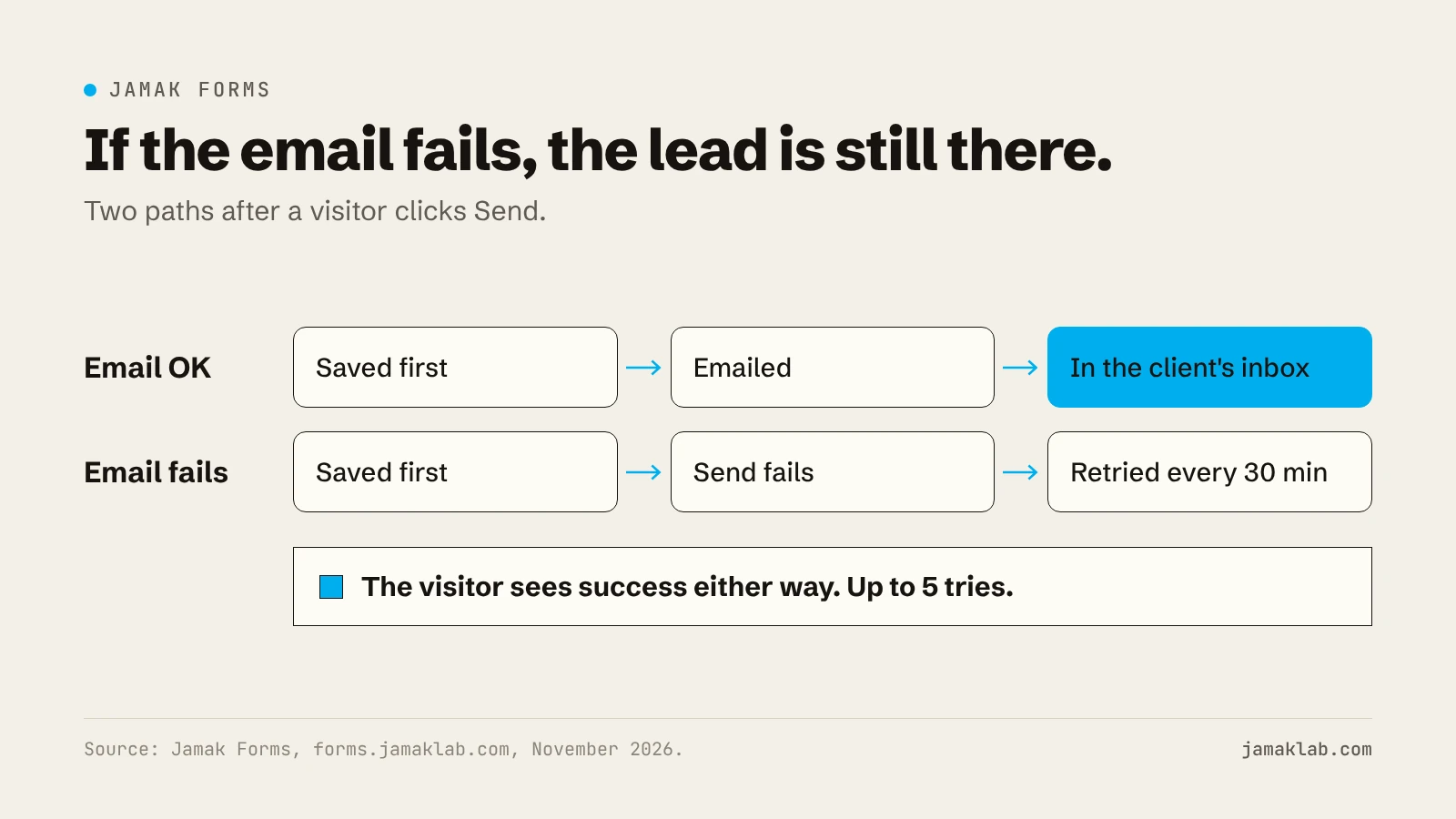
No lost leads. Every message is saved in our database before any email goes out. If the email fails, the lead is still there, and we try again every 30 minutes, up to five times.

A fallback when everything is down. If we can't save or send, the visitor sees the client's direct contact instead of a dead end, for example a WhatsApp number.
Nothing to set up. The emails come from a Jamak address we verified once. The client doesn't touch DNS, doesn't create an account and doesn't pay a plan.
Why one form account per site fell short
A form service is a fine answer for one website. It's a poor one for an agency with many sites, for three reasons.
The lead is the product. A contact form exists to produce leads. Leaving them in a vendor's dashboard, under an account the client never opens, means the one thing the site is for lives in the place nobody looks.
Some leads are sensitive. Some of our clients are doctors. A message to a clinic can say why someone wants an appointment. We want to know exactly where that text is stored, who can read it and when it gets deleted.
Costs multiply. Each site needs its own plan once it outgrows the free tier. Multiply that by every client and it's a line item for a form.
| One form account per site | Jamak Forms | |
|---|---|---|
| Client setup | Sign up, verify, pick a plan | None |
| Where the lead lives | The vendor's dashboard | Our database, then the client's inbox |
| How the email looks | The vendor's template | The client's brand |
| If the email fails | Depends on the vendor | Retried every 30 minutes, up to 5 times |
| Monthly cost per site | A plan, once you outgrow the free tier | No new bill |
What it does behind the form

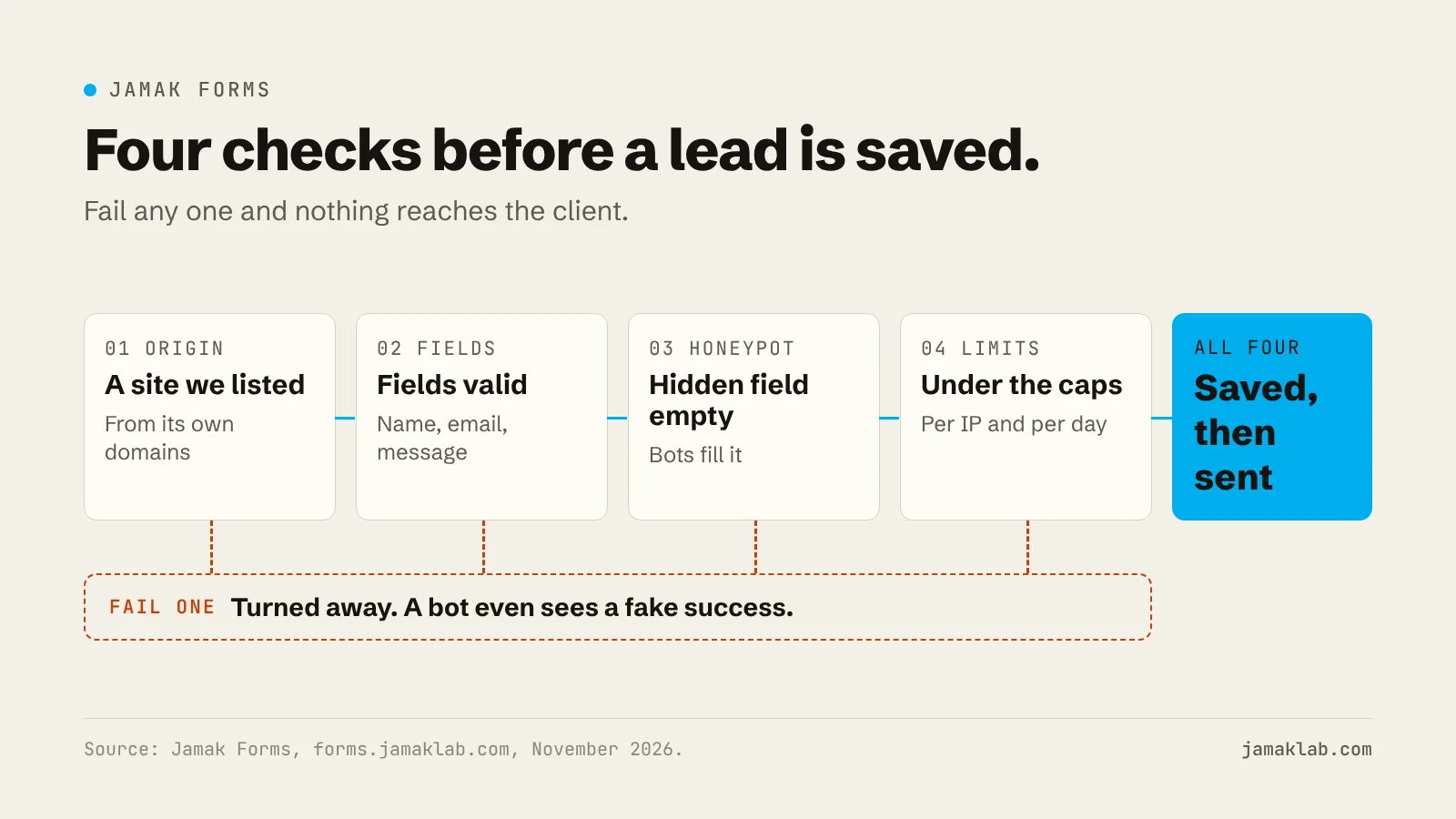
- Only listed sites can post. Each client site has an entry in our registry: its domains, who receives the leads, the subject line and the brand. The registry decides where a lead goes, never the visitor's browser.
- Bots get a polite nothing. A hidden honeypot field catches most bots, which get a "success" and store nothing. Repeated sends from one IP address and a daily cap per site stop floods.
- We hear about problems first. A bounce, a complaint or a failed send on a real lead raises an alert with the site's name. Every day a test lead goes through the whole path, so a broken sender shows up before a client notices.
- Counts, not contents. Every Monday we get a lead count per site for the last 7 and 30 days, and a flag on any site with no leads in 30 days. A site whose form went quiet is usually a broken site.
- Old messages don't pile up. After 12 months the message, the visitor's email and the IP fingerprint are removed. The date, the site and the delivery status stay, so the counts still add up.
What it leaves out on purpose
No form builder, no file uploads, no client logins, no newsletters, no auto-reply to the visitor and no CRM sync. Jamak Forms does one job: get a contact message from a site we built to the person who should answer it, without losing it.
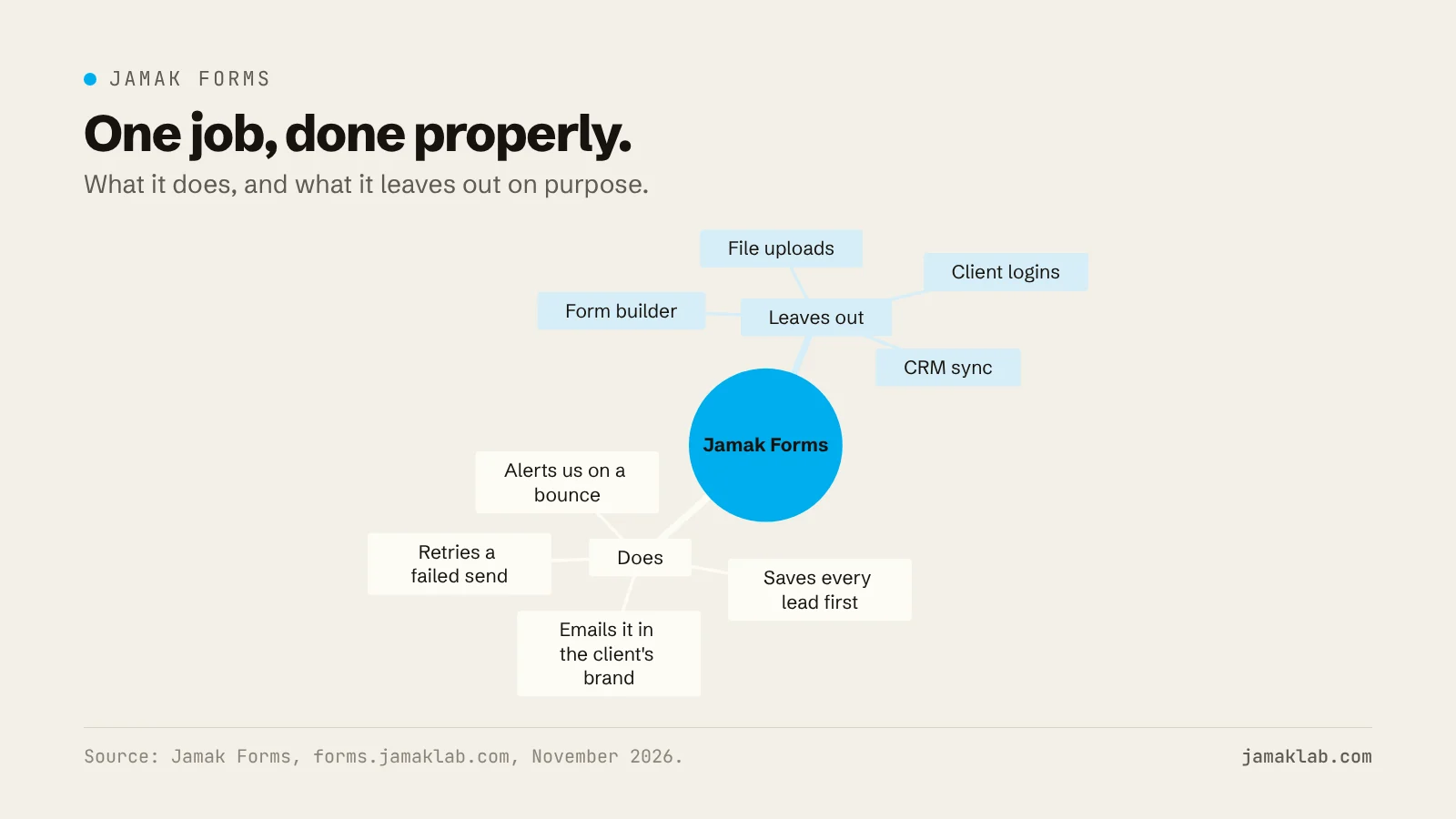
If a project needs more than that, a quote form with ten fields or a booking flow, it gets built into that project. Not bolted onto a generic form tool.
Where it is today
The service is live at forms.jamaklab.com. The first client site, a medical practice, is moving its contact form from a form subscription to Jamak Forms now, and every site we build next starts on it.
Adding a site takes one registry entry. A React or Next.js site uses a small hook we copy into the project, and the build fails if the site's ID is wrong, so a typo can't ship a form that posts nowhere. A plain HTML site adds one attribute to its <form> and one script tag.
This is how we like to build for clients: own the boring part once, do it properly, and stop paying rent on it. If your site's form sends leads to an inbox nobody trusts, tell us about it. And if you're a clinic, here's what we build for doctors.
Frequently Asked Questions
Q: What is Jamak Forms?
A contact-form service built by JAMAK for the websites we build. Each site's form posts to forms.jamaklab.com, which saves the message, then emails it to the client in the client's own brand, with the visitor as the reply-to address.
Q: Do clients pay a subscription for their contact form?
No. Sites we build use Jamak Forms with no form-service account and no plan. The client doesn't sign up for anything or touch DNS.
Q: What happens if the email fails to send?
The lead is already saved before any email goes out. A job retries unsent leads every 30 minutes, up to five times, and a bounce or failure on a real lead raises an alert for our team.
Q: How does Jamak Forms stop spam?
A hidden honeypot field catches most bots, which are shown a success and stored nowhere. On top of that there's a limit on sends from one IP address and a daily cap per site.
Q: How long are contact messages kept?
Twelve months. After that the message text, the visitor's email and the IP fingerprint are removed, and only the date, the site and the delivery status stay for the counts.
Q: Can I use Jamak Forms on a site JAMAK didn't build?
Not as a standalone product today. It's part of the sites we build and maintain. If you want us to take over your site, ask for a quote.