Why your backlink count is inflated (and what to do about it)
By José Antonio Mijares | 2026-10-24 | 6 min read
Most new "backlinks" on a small site come from SEO-checker pages that print a page for every domain they see. Google discounts them. Here is how to spot them and what to count instead.
Your backlink tool says you have hundreds of new links. Most of them are not links anyone chose to give you. They are pages that SEO-checker sites print automatically for every domain they crawl.
Google discounts them. You should too, once you know how to spot them.
What we found on our own site
We ran jamaklab.com through Ezeo, the SEO and AI-visibility platform we build, in October 2026.
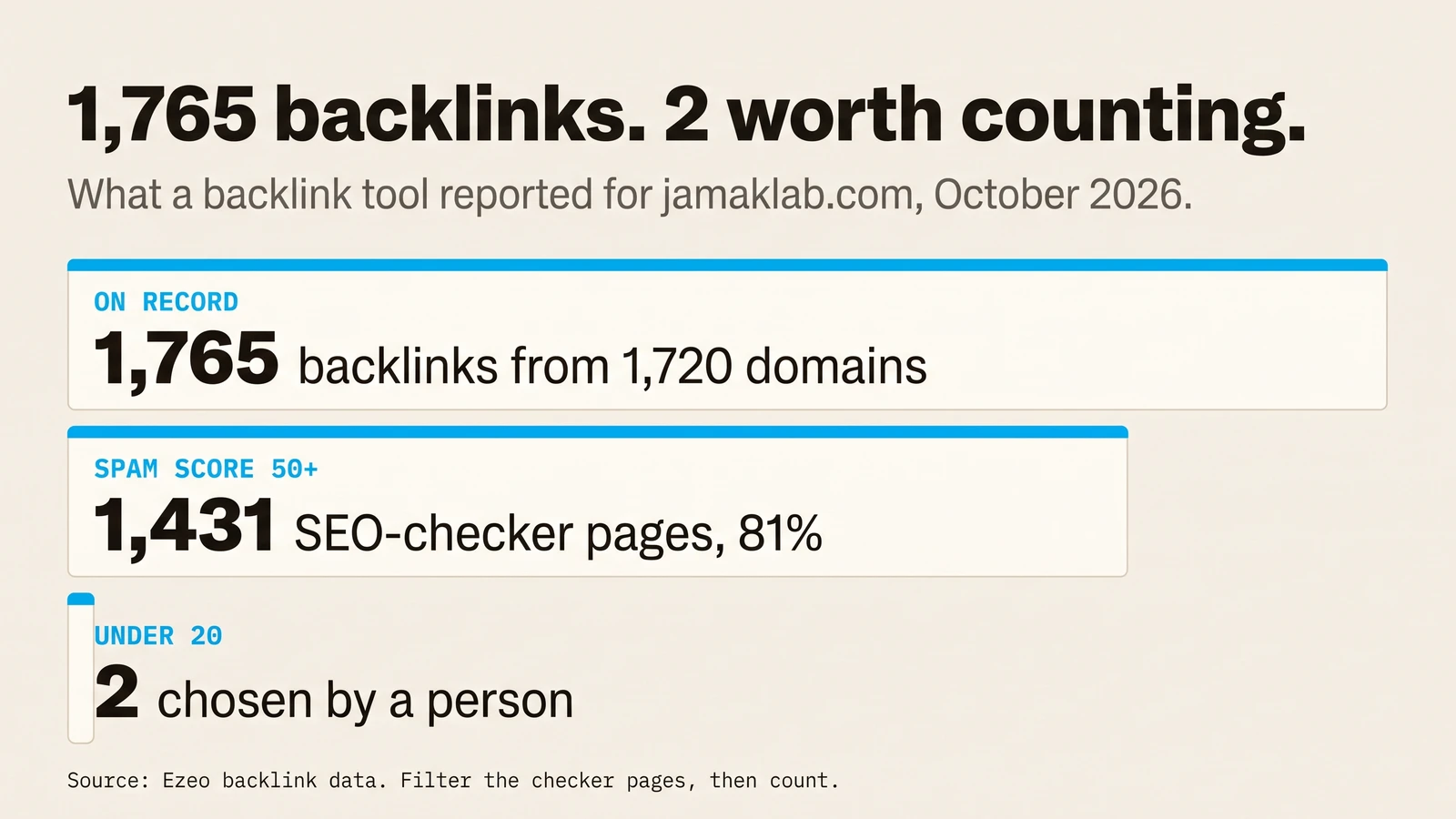
- 1,765 backlinks on record, from 1,720 referring domains.
- 1,431 of them scored 50 or more on spam score. That is 81%.
- 2 scored under 20.
- Most used the same anchor text: "jamaklab.com Premium Backlink Building for Higher Google Search Positions".
The domains look like this: backlinkchecker.site, dapachecker.store, seopbn.space, freebacklinkgenerator.online. Hundreds of near-identical names on .store, .website, .space, .site, .shop and .online.
Nobody at JAMAK bought these. Nobody asked for them. They arrive on their own.
Where these links come from
Some sites exist to rank for searches like "check my domain authority" or "free backlink checker". To have a page for every query, they generate one for every domain they see: yours, ours, everyone's. Each generated page links back to the domain it describes.
To a crawler, that is a link. To a backlink tool, that is a new referring domain. To Google, it is noise.
Does Google count them?
No, not in any way that helps or hurts a normal site. Google's spam policies describe links made by automated programs as link spam, and Google's systems are built to discount them.
That is why the disavow tool is meant for one case: links that caused a manual action, or are likely to. If Search Console shows no manual action under Security and Manual actions, you do not need a disavow file for checker spam.
How to spot them in five minutes
- Sort referring domains by TLD. A cluster of .store, .site, .space, .online and .website domains is the signature.
- Read the domain names. "checker", "backlink", "dapa", "seo", "rank", "traffic" in the name, over and over.
- Read the anchor text. Templated anchors like "yourdomain.com Premium Backlink Building" are generated, not written.
- Check the spam score column. Most tools show one. A wall of 45 to 60 is the pattern.
- Look for a page about you. Open one. If it is a stats page about your domain with no reason to exist, that is the source.
What to count instead
A real backlink is a link a person chose to put on a page people read. Count those:
- Referring domains with spam score under 20, excluding the checker pattern above.
- Links from pages that get traffic, not just from domains with a score.
- Links with a reason: a citation in an article, a partner listing, a client's credits page, a directory you applied to.
On jamaklab.com that number is small. That is the honest starting point, and it is the one we track.
What to do instead of disavowing
Fix the tool, not Google. Filter checker domains out of your backlink report so the total stops lying to you.
Recover links you already earned. If you changed domains, make sure the old domain 301-redirects page by page. Links to a dead domain help nobody.
Earn the next ten. Partner directories you qualify for, client credit pages, a useful open-source tool, original data a journalist can cite. Ten real links do more than ten thousand generated ones.
Frequently Asked Questions
Q: Should I disavow spam backlinks from SEO-checker sites?
Not unless Search Console shows a manual action. Google already discounts links made by automated programs, and its disavow tool is meant for links that caused or are likely to cause a manual action.
Q: Why did my backlink count jump overnight?
Usually because a network of SEO-checker sites generated a page for your domain. Look for clusters of .store, .site, .space and .online domains with templated anchor text.
Q: Can someone hurt my rankings by pointing spam links at my site?
Google treats links made by automated programs as spam and works to discount them rather than reward or punish the site they point at. If you ever receive a manual action for unnatural links, a disavow file is the tool for it.
Q: How many real backlinks does a small business site need?
There is no fixed number. A handful of relevant links from pages people actually read is worth more than any total in a backlink tool.
Q: Do spam backlinks affect AI answers like ChatGPT or Perplexity?
There is no public evidence that they help. AI engines cite pages they can read and trust. How to check if ChatGPT cites your brand is the method we use.
Jamak does SEO and GEO for stores and SaaS. The ranking work is SEO. The citation work is GEO. Talk to us. No rate card. No fake results.